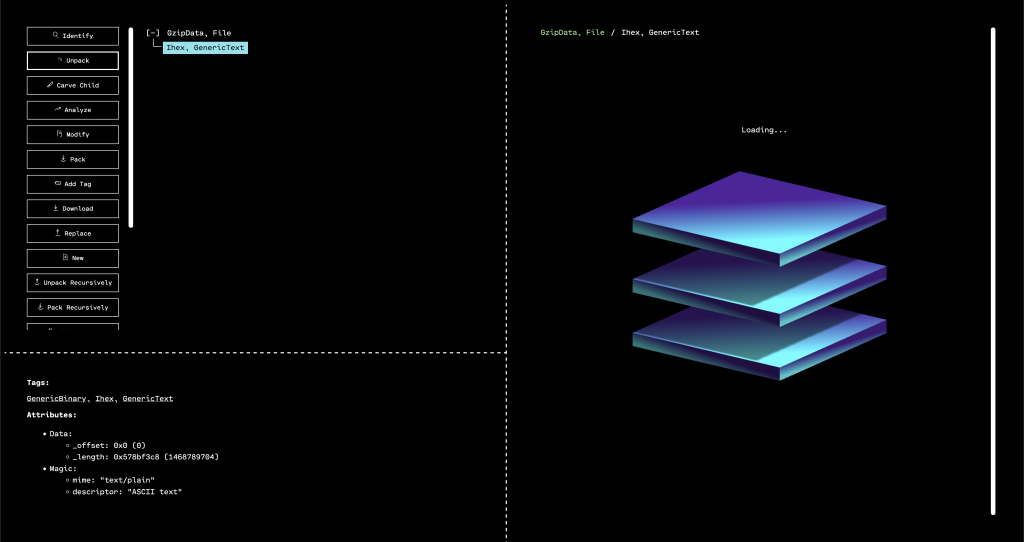
One of the neat features we’ve had in mind for the OFRAK GUI, almost since it came out, is to be able to show you a Python script version of your actions in the GUI.
This is helpful for a few reasons: remembering what you did, learning the Python API, generalizing your work in the GUI to a reusable script or component, and probably more.
Now whenever using the GUI, it is possible to click the “Show Script” button to view or download the generated Python script. There are few basic types of API calls you’ll see in the generated scripts. The simplest ones are invocations of unpack, analyze, identify, etc. These correspond directly with the buttons in the GUI. Another type you might see are the modifier invocations that implement the string or bytes find-and-replace buttons in the GUI. There will also be a lot of get_only_child calls. What’s up with that? Well, OFRAK doesn’t know why the user selected the resources they clicked, so when you select a resource and run an action on it, OFRAK needs to come up with some logic to specify that resource before, for example, unpacking it. This generated logic may or may not match with why you actually did click the resource for some further action. It could be a good exercise to look for these in the generated script and consider how to alter these queries to fit what’s in your head.
This code isn’t necessarily going to “just work” like magic – for example, it needs the file you are using as the root resource to be in the script’s working directory, so that it can load it. If you run it on another file, the generated resource selection logic may be too specific to the file the script was initially generated on. But we encourage you to try it out – do a bit of exploration in the GUI, then hit “Show Script” to see the Python version. If you’ve only played around with the GUI, this could be a sign to try your hand at Python.
A couple helpful little arguments were also added to the command-line interface in this update, which are worth mentioning (these are in the subcommands gui, identify, and unpack). The --import <file-or-module> (shorthand: -i <file-or-module>) option allows specifying additional Python modules or files to discover when launching OFRAK. This is especially helpful when working on a small extension for OFRAK, defining some new components, tags, etc. because the file with those definitions can be imported to try out the new code live. The other argument is -f <file-path> which passes a file to be immediately loaded into the GUI, saving the step of dragging it into the GUI after launching. Both of these arguments can be repeated multiple times, to discover multiple modules or load multiple files as Resources.
Oh, and one more thing. The generated scripts will get much more interesting as we add more features to the GUI. In particular, the upcoming GUI interface to run any OFRAK component will allow a lot more to be done with the GUI. You’ll be able to select and run any component, and see that invocation show up in the generated script.
Okay, that’s all for now — if you haven’t already, go and pip install ofrak! Happy OFRAKing!